Jul 9, 2026
HS Chapter 4202 Decoded: Why Backpacks, Handbags, and Travel Bags Have 17 Different Duty Rates
HTSUS Heading 4202 covers backpacks, handbags, travel bags, and similar containers, with classification driven by the type of article, its outer surface material, and the applicable tariff provisions. Those distinctions can produce very different duty outcomes. For example, a backpack with an outer surface of man-made textile materials may attract a 17.6% duty rate, while similar articles classified under different HTSUS subheadings for cotton or leather may carry significantly lower rates.
Those distinctions affect far more than the duty rate. They influence landed-cost calculations, customs declarations, and the risk of classification disputes during a CBP review. A clear understanding of how Heading 4202 is organized, how CBP applies the tariff provisions, and where Chapter 99 measures layer on top of the base duty helps importers classify goods more accurately and avoid costly post-entry corrections.
What Information Do You Need Before Classifying a 4202 Product?
Most 4202 classifications can be resolved quickly when the right product information is available upfront. Before reviewing the tariff schedule, gather the details that Customs uses to distinguish one bag, case, or container from another.
Start with the container type. A backpack, handbag, wallet, travel bag, suitcase, or jewelry box may all fall under heading 4202, but each follows a different subheading path. Next, identify the outer-surface material. For many 4202 products, this is the single most important classification factor. Customs primarily considers the material forming the article’s outer surface. In many cases, this corresponds to what is visible and tactile from the exterior rather than the material beneath it.
If the outer surface is textile, you'll also need the fiber composition. Cotton, man-made fibers, silk, and other vegetable fibers can each lead to different tariff outcomes.
A few products require additional details:
Leather handbags: Confirm the per-unit customs value, as the $20 threshold affects classification and duty treatment.
Woven polypropylene bags: Confirm the strip width, since strips measuring 5 mm or less are treated differently from wider strips.
Once these details are confirmed, the HTSUS provides the applicable subheading and base duty rate. Any Chapter 99 tariffs, such as Section 301 duties, should then be reviewed separately because they are not reflected in the Chapter 42 rate itself.
How Is Heading 4202 Actually Structured?
The 4-digit heading text covers an extraordinary range of carrying articles, then limits coverage to articles "of or covered with" five specified surface materials: leather or composition leather, sheeting of plastics, textile materials, vulcanized fiber, or paperboard/paper. An all-metal jewelry box - the right kind of container but in the wrong material - falls outside 4202 unless it is wholly or mainly covered with a listed material.
Inside the heading, the 6-digit subheading architecture uses a two-level matrix:
HS 6-digit group | Container type |
|---|---|
4202.1x | Trunks, suitcases, vanity cases, attaché cases, briefcases, school satchels |
4202.2x | Handbags (with or without shoulder strap) |
4202.3x | Articles normally carried in the pocket or handbag (wallets, key cases, tobacco pouches) |
4202.9x | Other (travel bags, sports bags, backpacks, shopping bags, tool bags, bottle cases, jewelry boxes) |
Within each group, classification continues based on the outer-surface material. Leather products follow one set of provisions, plastics and textiles another, while products made from other materials follow separate classification paths. At the U.S. subheading level, additional distinctions such as fiber composition, customs value, and construction details can further affect the final HTS code and duty rate.
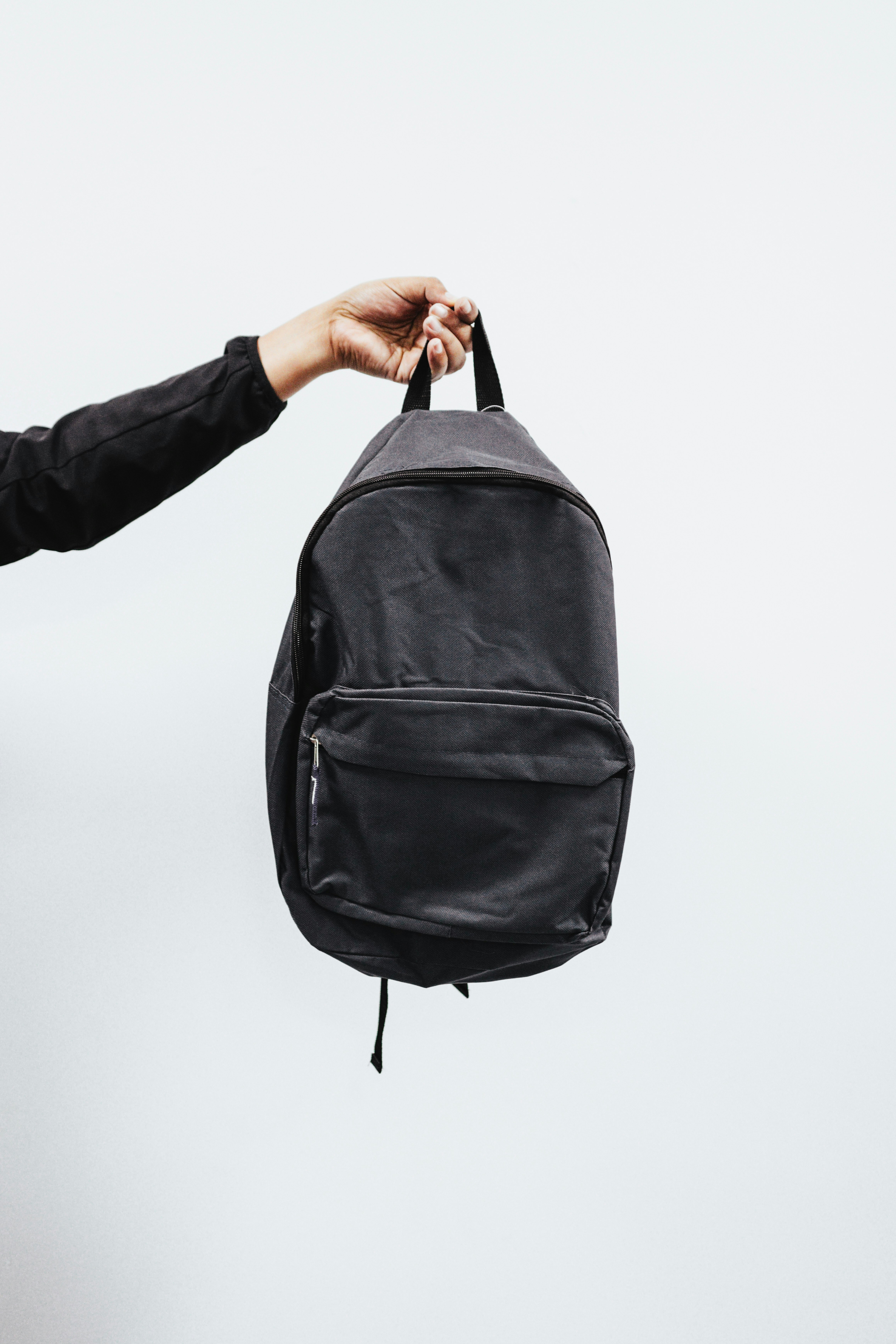
One point that often surprises importers is that backpacks do not have a dedicated heading of their own. Under Additional U.S. Note 1 to Chapter 42, backpacks and shopping bags designed to carry clothing or personal effects are treated as "travel, sports, and similar bags." As a result, they are generally classified within the 4202.91 or 4202.92 series alongside other travel and sports bags.
The note also draws clear boundaries around what belongs in this category. Products such as camera cases, binocular cases, musical instrument cases, and similar specialized containers follow their own classification paths rather than being treated as travel or sports bags.
What Does the 4202 Rate Matrix Look Like in Practice?
The Column 1-General (MFN) rates inside heading 4202 produce at least 17 distinct outcomes before any Chapter 99 overlay attaches. The principal subheadings:
Trunks, suitcases, briefcases (4202.1x)
Subheading | Defining attribute | MFN Rate |
|---|---|---|
4202.11.00 | Outer surface of leather or composition leather | 8% |
4202.12.21 / 4202.12.29 | Outer surface of plastics | 20% |
4202.12.40 | Outer surface of textile - cotton or vegetable fibers | 6.3% (cotton) / 5.7% (other vegetable) |
4202.12.81 / 4202.12.89 | Outer surface of textile - man-made fibers or other | 17.6% |
4202.19.00 | Other (vulcanized fiber, paperboard, other) | 20% |
Handbags (4202.2x)
Subheading | Defining attribute | MFN Rate |
|---|---|---|
4202.21.30 | Leather - reptile leather | 5.3% |
4202.21.60 | Leather - valued not over $20 each | 10% |
4202.21.90 | Leather - valued at over $20 each | 9% |
4202.22.15 | Sheeting of plastics | 16% |
4202.22.45 | Textile - cotton (non-braid, non-pile) | 6.3% |
4202.22.60 | Textile - other vegetable fibers | 5.7% |
4202.22.70 | Textile - ≥85% silk | 7% |
4202.22.81 / 4202.22.89 | Textile - man-made fibers or other | 17.6% |
4202.29.10 / 4202.29.20 | Other (plastics / wood) | 5.3% / 3.3% |
Pocket articles - wallets, card cases, key cases (4202.3x)
Subheading | Defining attribute | MFN Rate |
|---|---|---|
4202.31.30 | Leather - reptile | 3.7% |
4202.31.60 | Leather - other | 8% |
4202.32.10 | Plastics - reinforced/laminated | 12.1¢/kg + 4.6% |
4202.32.20 | Plastics - other | 20% |
4202.32.40 | Textile - cotton, vegetable fibers | 6.3% |
4202.32.85 | Textile - ≥85% silk | Free |
4202.32.91 / 4202.32.93 | Textile - cotton (MMF sub) / MMF | 17.6% |
Travel, sports, and similar bags (4202.9x)
Subheading | Defining attribute | MFN Rate |
|---|---|---|
4202.91.10 / 4202.91.90 | Leather - golf bags / other travel-sports | 4.5% |
4202.92.04 / 4202.92.08 | Plastics/textile - beverage hydration / outer plastics | 7% |
4202.92.15 | Textile - cotton | 6.3% |
4202.92.20 | Textile - other vegetable fibers | 5.7% |
4202.92.31 | Textile - man-made fibers (includes nylon backpacks) | 17.6% |
4202.92.45 | Other plastics/textile residual | 20% |
4202.92.50 | Musical instrument cases | 4.2% |
4202.99.30 | Other materials, lined with textile | Free |
For SKU portfolios with material variations across the same product family, the Gaia bag HS code lookup surfaces the subheading by container type and outer-surface combination - faster than manual triangulation across a five-page tariff schedule.
Why Do the Rates Diverge, and Which Factors Matter Most?
The wide range of duty rates within heading 4202 comes down to four primary factors:
Outer-surface material
The outer surface is often the biggest rate driver. For handbags alone, the difference is significant: leather handbags valued over $20 each carry a 9% duty rate, plastic-surface handbags carry 16%, cotton handbags 6.3%, and man-made fiber handbags 17.6%.
Fiber content
Once an article falls into a textile category, fiber composition becomes the next major differentiator. A nylon backpack classified under 4202.92.31 carries a 17.6% duty rate, while a similar cotton backpack under 4202.92.15 carries 6.3%. The product may look nearly identical, but the outer textile changes the tariff treatment.
Value
Leather handbags are one of the few areas in heading 4202 where customs value directly affects classification. Articles valued at $20 or less per unit fall under a different provision than those valued above $20, resulting in different duty rates.
Container type
The same material can attract different duty rates depending on what the product is. Leather luggage, handbags, wallets, and travel bags each follow separate tariff provisions, even when made from similar materials.
A few specialized provisions also sit outside the standard pattern. Certain silk articles receive duty-free treatment, while musical instrument cases qualify for their own dedicated tariff provision and rate.
Understanding the Outer-Surface Test
For many products classified under heading 4202, the outer surface plays a major role in determining the correct HTS code. Customs does not focus on the material hidden underneath. Instead, it looks at what a person can see and feel from the outside of the product.
This is commonly known as the visual-and-tactile test.
Two CBP rulings illustrate how the test works:
A handbag made with interlaced PVC and cotton strips was classified as a textile-surface article because the cotton created the visible and tactile character of the exterior
A cotton bag coated with clear polyurethane was classified as having a plastic outer surface because the plastic coating was what the user actually touched, even though the textile remained visible underneath.
The same principle applies to coated and laminated fabrics. If the plastic layer dominates the exterior surface, Customs treats the article as having a plastic outer surface. If the textile layer dominates, it is treated as a textile-surface article.
A practical way to approach the question is simple: look at the product and touch the exterior. Ask yourself whether the surface feels primarily like fabric or plastic. In many cases, that observation points directly to the correct classification path. Where the answer is unclear, a CBP binding ruling can provide certainty before future shipments are entered.
The 4202 Classification Process Step by Step
Most 4202 products can be classified by working through a simple six-step process. Each step narrows the available subheading options until only the correct classification remains.
Step 1: Confirm the product belongs in heading 4202
Before classifying the article, confirm that it is not covered by another heading. For example, certain plastic bags designed for packing or transport may fall under heading 3923, while articles made from plaiting materials may fall under heading 4602. For woven polypropylene products, strip width can be important because strips measuring more than 5 mm are generally treated as plaiting materials rather than textiles.
Step 2: Identify the container type
Determine whether the product is a handbag, wallet, backpack, travel bag, suitcase, briefcase, or another type of container. This establishes the correct 6-digit subheading group within heading 4202.
Step 3: Determine the outer-surface material
Apply the visual-and-tactile test to identify the material that forms the visible and tactile exterior of the product. Leather, plastics, textiles, and other materials each follow different classification paths.
Step 4: Confirm the fiber composition for textile products
If the outer surface is textile, identify the fiber type. Cotton, vegetable fibers, man-made fibers, and silk can all lead to different subheadings and duty rates.
Step 5: Apply any value-based rules
Some provisions require additional checks. Leather handbags, for example, use a value threshold that can affect the final classification and duty treatment.
Step 6: Review Chapter 99 duties
The Chapter 42 duty rate is only the starting point. Additional duties under programs such as Section 301 and other Chapter 99 provisions should be reviewed separately because they may increase the final landed cost.
Following these six steps in sequence helps ensure that the classification is based on the product's actual characteristics rather than assumptions about its appearance or use.
What Does a Well-Managed 4202 Classification Program Look Like?
Accurate classification across a large 4202 portfolio comes down to consistency. Three checkpoints help reduce the risk of misclassification and support stronger audit readiness.
Checkpoint 1: Document every outer-surface determination
Products with coated, laminated, or composite exteriors should have a documented basis for the outer-surface classification. Photographs, product samples, testing records, or CBP ruling references help support the visual-and-tactile determination used during classification.
Checkpoint 2: Review leather handbag valuations regularly
Leather handbags classified around the $20 customs-value threshold should be supported by current valuation documentation. Related-party transactions, assists, and valuation adjustments can affect the applicable tariff provision, making periodic reviews important.
Checkpoint 3: Validate prolonged-use determinations for shopping bags
Products classified as shopping bags should have documentation supporting whether they are designed for prolonged use. Construction, durability, and product characteristics generally carry more weight than marketing descriptions when evaluating the correct classification path.
For a deeper walkthrough of CBP's reasonable-care expectations and the controls that support classification accuracy at scale, the Gaia CBP classification primer explores the process in greater detail.
Understanding Additional Duties Beyond Heading 4202
The duty rate shown in heading 4202 is often only the starting point. Many imports are also subject to additional tariffs reported through Chapter 99 provisions, which apply on top of the base HTS classification.
One of the most common examples is Section 301. Most 4202 products originating in China are subject to an additional 25% duty under the applicable Chapter 99 provision, increasing the total landed-duty cost significantly. For example:
Duty Component | Rate |
4202.92.31 (nylon backpack) | 17.6% |
Section 301 additional duty | 25% |
Combined duty rate | 42.6 |
The same product can therefore carry very different duty outcomes depending on its country of origin and any applicable Chapter 99 measures.
Before filing an entry, importers should review both the Chapter 42 classification and any active Chapter 99 provisions. The base HTS code determines the starting point, but additional tariff programs often determine the final landed-duty cost.
How Do You Keep the 4202 Program from Drifting?
Classification decisions do not stay static forever. Changes in materials, suppliers, tariff programs, and Customs guidance can all affect how a product should be classified and what duty rate ultimately applies.
The challenge is that many 4202 classifications can change without the product itself appearing meaningfully different. A supplier swaps canvas for polyester, adjusts polypropylene strip width, adds a coating, or changes the composition of an outer surface, and the tariff treatment can shift with it.
Explore Gaia to compare classifications across material variations, validate outer-surface determinations, and understand how product changes affect duty treatment before the next shipment is prepared.
Frequently Asked Questions
What turns a "shopping bag" into a 3923 article instead of a 4202 article?
Durability is the key factor. Plastic bags not designed for prolonged use are generally classified under heading 3923, while reusable bags designed to withstand repeated use are typically classified under heading 4202.
Does a woven polypropylene tote bag belong in 4202 or 4602?
It depends on the strip width. Polypropylene strips measuring 5 mm or less are generally treated as textile material and classified in heading 4202. Strips wider than 5 mm are treated as plaiting material and generally fall under heading 4602.
How does the $20 handbag value threshold interact with related-party valuation?
The threshold is based on customs value per unit rather than the invoice price alone. Valuation adjustments, assists, and related-party pricing arrangements can affect whether a handbag falls above or below the $20 threshold.
What is the boundary between 4202 and 4205 for a leather pouch?
A leather pouch is generally classified in heading 4202 when it functions as a container for carrying personal effects. Products that do not have that container character may fall under heading 4205 as other articles of leather.
Does a fitted case classified under GRI 5(a) always fall outside Heading 4202?
No. When a fitted case is imported with the article for which it is specially shaped or fitted, suitable for long-term use, and normally sold with that article, it is generally classified with that article under GRI 5(a). If imported separately, it is usually classified under Heading 4202.