Aug 10, 2026
How to Read an HTS Number: The 10-Digit Anatomy and the Chapter 99 Overlay Stack
An HTS number looks like a serial code, but it reads more like an address. Each pair of digits narrows the location, from a broad product family down to a single statistical reporting line, and every level is doing specific legal work. Read only part of the number, and you get part of the answer, which in tariff terms means the wrong duty. In 2026, with Chapter 99 overlays stacking Section 301 and Section 232 surcharges on top of base rates, the cost of misreading a code has never been higher.
HTSUS and HS: What's Shared and What's Ours
The HTSUS combines the internationally harmonized Harmonized System with US-specific categories and rates. The 4-digit headings and 6-digit subheadings in chapters 1 through 97 are administered by the World Customs Organization and are uniform across member countries. Everything beyond the sixth digit, and all of chapters 98 and 99, is US national law, proclaimed for the United States alone.
That split has a direct practical consequence. A supplier's tariff code from another country is only guaranteed to match the correct US classification through the first six digits, because each country subdivides the HS below that level for its own duty and statistical needs. Classification decisions have to be made against the HTSUS text and notes, not against a foreign code or a marketing description, which is the discipline every importer and exporter has to build into their entry process.
The 10 Digits, Level by Level
The International Levels: Chapter, Heading, Subheading
Under the HS, every product sits in a hierarchy:
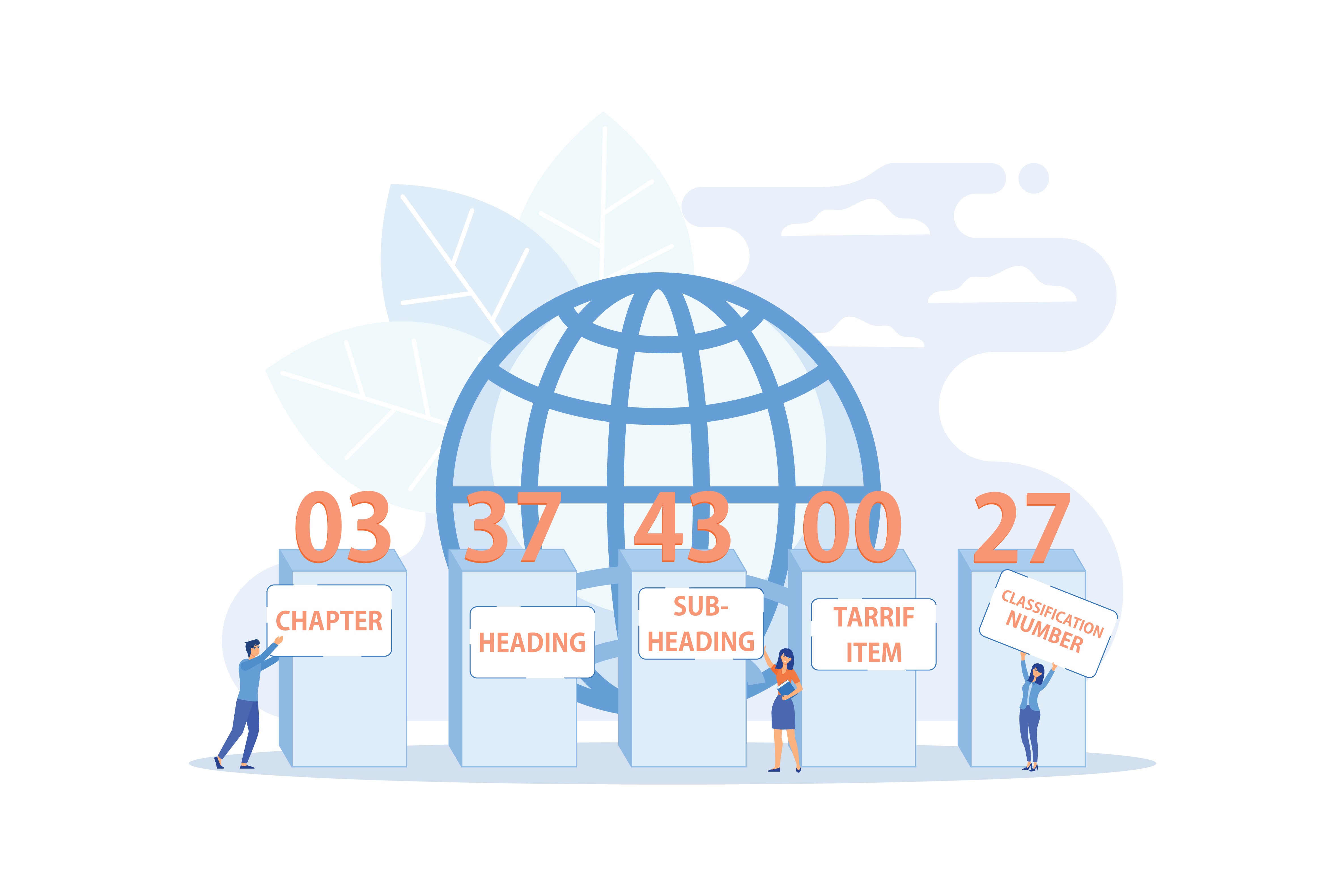
First 2 digits- The chapter: A broad product family. Chapter 09, for example, covers coffee, tea, maté, and spices.
First 4 digits- The heading: A more specific group. Heading 0904 covers pepper of the genus Piper and dried or crushed fruits of the genus Capsicum or Pimenta.
First 6 digits- The HS subheading: Which narrows the description further and is harmonized internationally.
The USITC notes there are more than 1,220 four-digit headings, and that classification begins by finding the most specific heading, then considering only the subheadings indented beneath it. You do not shop across headings at the subheading level; you commit to a heading first, then work down.
The US Levels: The 8-Digit Rate Line and the 10-Digit Suffix
The last four digits are ours. On a typical HTS page, the first column shows the 4-, 6-, and 8-digit headings and subheadings, and a separate "Stat Suffix" column adds the final two digits that complete the 10-digit reporting number. Two distinctions matter more than any other:
The legal text of the HTS ends at the 8-digit level: This is where duty rates are assigned. When people talk about "the rate line," they mean the 8-digit subheading.
The 10-digit statistical numbers are not legal text: They are mandatory for entry reporting and are used to collect trade statistics, but every 10-digit number falling within an 8-digit provision carries the same duty rate as that 8-digit provision.
So the eighth digit sets your duty, and the ninth and tenth set your reporting category and unit of quantity. Both have to be right on an entry, but they fail in different ways: an 8-digit error is a duty error, while a 10-digit error is a reporting and statistics error that can still affect quotas or monitoring.
The General Rules of Interpretation: Choosing the Heading
The General Rules of Interpretation are the legal framework for classifying goods in the HS and, by extension, in HTSUS chapters 1 through 97. There are six rules, and they are applied in sequence, not picked from. The official GRI text governs, and the practical version reads like this:
GRI 1, headings and notes first: Goods are classified according to the terms of the headings and any relative section or chapter notes. Section and chapter titles are for reference only and carry no legal weight. Most classifications are decided right here.
GRI 2, incomplete articles and mixtures: 2(a) extends a heading to an incomplete or unfinished article that has the essential character of the finished one, and to complete articles presented unassembled. 2(b) extends a reference to a material to include mixtures with other materials, with multi-material goods then resolved under GRI 3.
GRI 3, when multiple headings apply: For goods prima facie classifiable under two or more headings: 3(a) takes the most specific description; 3(b), if that fails, classifies by the component giving the goods their essential character; 3(c), if that also fails, takes the heading last in numerical order.
GRI 4, most akin: Goods that resist rules 1 through 3 go to the heading for goods to which they are most akin.
GRI 5, containers and packing: Fitted cases presented with their article and normal packing are classified with the goods.
GRI 6, the subheading level: Within a heading, classification into subheadings follows the same principles, comparing only subheadings at the same level.
For import staff and junior analysts, the workable sequence is: read the section and chapter notes to see if the product is explicitly included or excluded, use GRI 1 to pick the heading, use GRI 6 to walk down the indentation levels to the 6-digit subheading, and only reach for GRI 2 and 3 when composite goods or competing headings force the question. Section, chapter, and subheading notes are legally binding text, which is why keyword search alone is dangerous: a search for "purebred" can point you at a subheading for horses when your product is something else entirely.
Rate Columns and What They Control
Every HTSUS rate line includes three duty columns:
Column 1, General: The standard duty rate for countries with normal trade relations.
Column 1, Special: Reduced or duty-free rates available under free trade agreements and preference programs, identified by program symbols such as USMCA.
Column 2: Higher duty rates that apply to imports from a limited group of countries, currently Belarus, Cuba, North Korea, and Russia.
Unless an importer qualifies for and claims a special program, Column 1 General applies by default.
One detail that is easy to overlook is the endnote attached to a rate line. A reference such as "1/" can direct the reader to "See 9903.xx.xx", indicating that a Chapter 99 provision must also be reported. Missing that reference can mean overlooking an additional tariff measure, resulting in an incorrect duty calculation or an incomplete customs entry.
Chapter 99: The Overlay Stack
What Chapter 99 Does
Chapter 99 holds temporary legislation and modifications. Its provisions either temporarily amend a rate in chapters 1 through 98 or impose additional duties and import restrictions under collateral legislation. Crucially, the statistical notes require importers to report the Chapter 99 number in addition to the normal 10-digit statistical number from chapters 1 through 97 that would otherwise apply. This is where Section 301 measures on Chinese goods and other presidential tariff adjustments live, and they apply on top of the base classification, not instead of it.
How the Overlay Behaves
Chapter 99 is organized into subchapters, and the US notes set the behavior:
Subchapter I, additional duties: These are cumulative duties that apply in addition to the duties otherwise imposed, only for articles entered during the effective period stated for each subheading.
Subchapter II, temporary reductions: These apply a reduced rate in lieu of the normal rate during the specified period.
In practice, reading a code with an overlay means three steps: determine the base 10-digit HTSUS number using the GRIs, determine whether a Chapter 99 provision applies based on product, origin, and date of entry, and then report both numbers on the entry while calculating duty from both.
Section 301 and 232 as Overlays
The USITC publishes a table linking the base subheadings covered by additional China tariffs to their corresponding Chapter 99 headings. Although that table is not itself legal text, it confirms the mechanics: the product takes its base duty from its Chapter 1 through 97 classification, and any additional tariff from the applicable Chapter 99 subheading. Combination follows the subchapter rule. For cumulative additional duties, you add the Chapter 99 rate to the Column 1 rate; a Chinese-origin good with a 3.7 percent base rate and a 25 percent Section 301 overlay carries a combined 28.7 percent before any other measure. Determining whether a given code carries a Section 301 overlay is the step that most often separates a correct entry from an underpayment.
Reading a Full Rate Line: A Walkthrough Template
A concrete digit-by-digit walkthrough, using a current code and verifying every rate against the live HTSUS, follows this arc:
Start at the chapter and heading, identifying the 4-digit heading from the table of contents and chapter notes.
Apply GRI 1 and the relevant notes to confirm the heading.
Use GRI 6 and the subheading notes to select the 6-digit subheading.
Move to the 8-digit US subheading, where US-specific distinctions such as material composition set the rate.
Add the 10-digit statistical suffix, noting the statistical category and unit of quantity.
Read the Rates of Duty columns, checking Column 1 General, Column 1 Special with its program symbols, and Column 2.
Follow any endnotes, including references such as "See 9903.xx.xx."
Attach the Chapter 99 overlay codes and combine or substitute the duties per the subchapter rule.
At each step, the authoritative source is the live HTSUS on hts.usitc.gov and CBP's CROSS rulings database, never a secondary tool or a cached spreadsheet.
Common Mistakes Reading HTS Numbers
Classification errors usually fall into a handful of recurring patterns:
Stopping at the 6-digit HS code instead of identifying the correct US 8-digit rate line, which determines the applicable duty rate and program eligibility.
Ignoring the 10-digit statistical suffix, leading to incorrect reporting, quota issues, or errors in the required unit of quantity.
Relying on keyword searches instead of the legal notes, even though section and chapter notes may include or exclude products that appear to fit a heading.
Overlooking Chapter 99 overlay codes, resulting in additional duties, such as Section 301 or Section 232 measures, being omitted from the entry.
Skipping endnotes and cross-references, which often direct importers to additional provisions, including Chapter 99 overlays, that affect the final duty calculation.
Many classification errors occur because the HTSUS is read as a single code instead of a layered system. A complete classification requires the correct base HTSUS number, the appropriate statistical suffix, and any applicable Chapter 99 overlays
Why the Full Number Is the Only Number That Counts
A complete HTS classification includes the base rate line, the 10-digit statistical reporting number, and any applicable Chapter 99 provisions. Each layer should be checked against the current HTSUS and relevant CBP rulings, since relying on an earlier code can lead to incomplete reporting or an incorrect duty calculation.
Start a free trial of Gaia to validate HTS classifications, identify applicable Chapter 99 provisions, compare duty scenarios, and assess tariff exposure before entry.
Frequently Asked Questions
What is the difference between an HS code and an HTSUS code?
An HS code is the internationally harmonized portion of the classification, covering the first six digits. The HTSUS builds on that with US-specific 8-digit rate lines, 10-digit statistical suffixes, and Chapters 98 and 99. A supplier's code from another country is only guaranteed to match through the first six digits.
Which digit of an HTS number sets the duty rate?
The 8-digit subheading sets the base duty rate. The final two digits are used for statistical reporting. Section 301 or Section 232 duties may apply separately through Chapter 99.
What is a Chapter 99 overlay and when does it apply?
It is an additional HTSUS provision used for temporary measures such as Section 301 and Section 232 tariffs. It is reported alongside the base classification.
How do I know if my product needs a Chapter 99 code?
Start by reviewing the endnotes on the applicable HTSUS rate line, then confirm the product's country of origin and date of entry against the relevant Chapter 99 provisions. If an overlay applies, both the base HTSUS number and the Chapter 99 code must be reported on the customs entry.
Why can't I just use my supplier's tariff code?
Foreign codes generally align with the HTSUS only through six digits. You must determine the correct US rate line, statistical suffix, and applicable overlays.